OLD DOMINION 100
Pain, Suffering, and Coca-Cola: An Old Dominion 100 Race Report
On June 6, 2026, I lined up for the Old Dominion 100 in Woodstock, Virginia. To be completely honest, I’m still not entirely sure what compelled me to sign up for this race, but I committed and moved forward. The course is a relentless mix of gravel roads, pavement, rugged ATV trails, and singletrack.
My journey began Friday morning with a smooth, traffic-free six-and-a-half-hour drive from New York. I arrived before 5:00 PM, giving me just enough time to check in, grab my bib, and attend the pre-race orientation. Going into this event, my calculations were off—I hadn't anticipated significant elevation or highly technical terrain. I was mistaken.
Then there was the weather. The forecast threatened a scorching 31°C (88°F). I knew the heat would be my fiercest opponent, and it did not disappoint. Exhausted from the long drive and a restless night, I fell asleep early Friday evening. Fortunately, when my alarm went off at 2:45 AM on Saturday, I woke up feeling surprisingly refreshed, sharp, and ready to roll.
The Smooth Early Miles
The race commenced at 4:00 AM as a pack of one hundred ultrarunners charged into the darkness. The first few miles on the pavement felt smooth and effortless. The morning air was crisp, and I felt incredibly calm and relaxed—a rare peace I hadn't often experienced in early race miles.
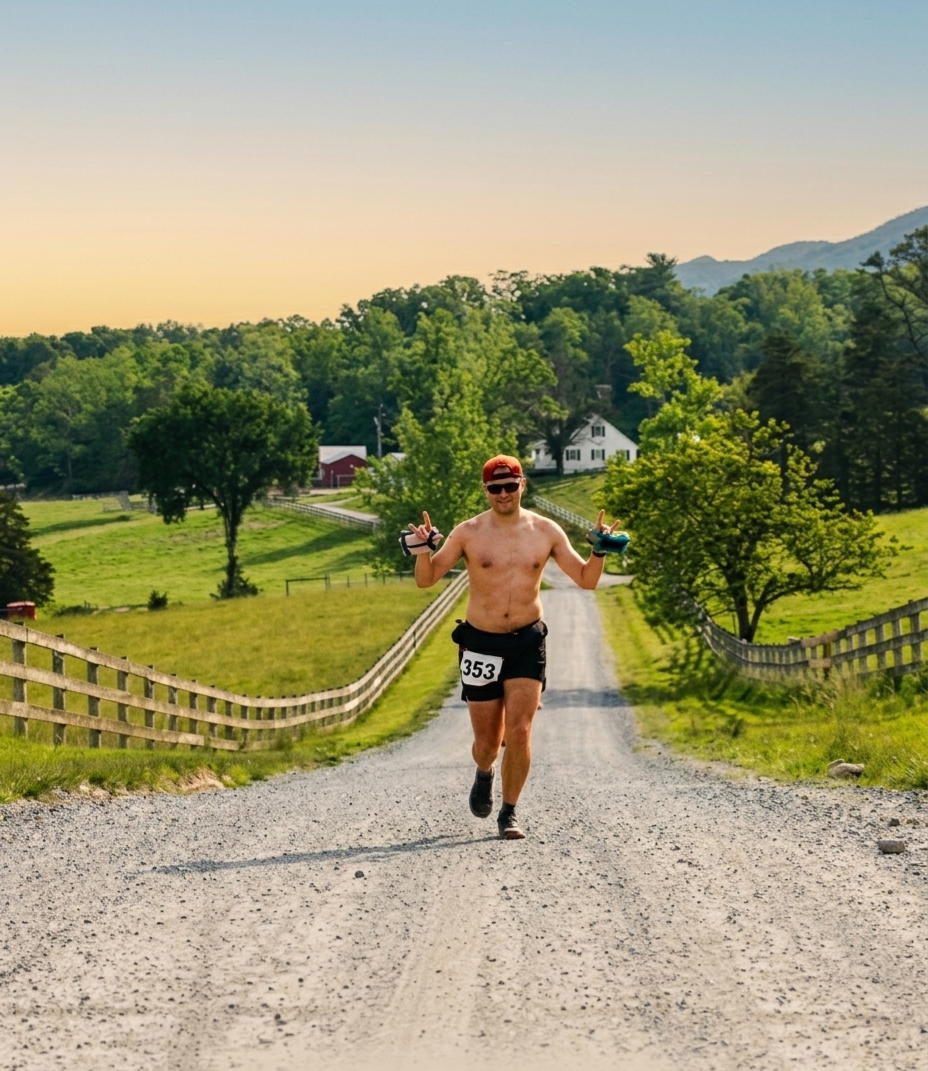
As the first light of dawn broke through the trees, I turned off my UltrAspire headlamp. Anticipating the rising temperatures, I took off my singlet and tucked it into my waist belt to maximize ventilation. Running shirtless felt right, even if the weight of my gear—protein bars, electrolyte tubes, and a jacket packed into my belt—kept dragging my shorts down, forcing me to hitch them back up every few bumps.
My initial strategy was simple: eat a protein bar with water every two hours, and carry two handheld bottles instead of a vest to eliminate chafing. One bottle held plain water; the other was mixed with electrolytes. This system worked beautifully for the first half of the race. I kept a disciplined, steady pace, hitting the 50-mile mark in exactly 9 hours and 30 minutes. The early climbs felt manageable, and heavy cloud cover shielded me from the worst of the sun.
By the 100K mark, I crossed the mental timing mat at roughly 13 hours and 30 minutes. My pace was slowing, but I felt stable.
Little did I know, the real race was about to begin.
Facing the Fire
The most brutal, technical singletrack and the largest climbs loomed after mile 74. Right on cue, the clouds vanished. The sun emerged from its hideout, scorching my head through the perforations of my racing hat. Thankfully, the aid stations were stocked with ice, which became my lifeline. I stuffed it under my hat and crammed it into both handheld bottles to keep my core temperature down.
Inevitably, the relentless heat turned my stomach. Solid food was no longer an option; every attempt to eat was instantly rejected. Even plain water and electrolyte drinks made me nauseous. In a bid for survival, I forced myself to drink Coca-Cola for raw calories and hydration. After a brief rebellion, my stomach finally accepted it. From that point on, I filled my bottles with nothing but Coke at every single stop.
As an ultrarunner once told me after a race, "I’ve never drank so much Coke in my life." My thoughts exactly. Coke became my fundamental nutrition; without it, I wouldn’t have finished.
The Midnight Lowest Point
As the afternoon waned, I found myself lingering longer at aid stations, desperately trying to recover my energy. The atmosphere at the checkpoints grew heavy as I watched other runners make the heartbreaking decision to DNF (Did Not Finish). I had to force myself to stand up and walk back into the heat. The joy of running was entirely gone. I was sick, depleted, and cursing out loud to the empty woods.
Expectations of a cool night vanished as darkness fell. The humidity hung thick, and sweat poured off me as if I were trapped in a mid-summer jungle. I cursed my naive calculations again—there were major climbs, and there was no reprieve from the nighttime heat.
My lowest point hit in the dead of night. In deep physical agony, I began bargaining with myself, swearing I would never race this distance again, and that I would stick to casual solo runs rather than signing up for these stupid events. Yet, dropping out never seriously crossed my mind. I just suffered, moaned, and kept moving.
Then, I realized there was less than 20K left to the finish line.
The Finish Line Sabotage and Camaraderie
Something shifted. I stopped managing my pain and started racing again, pushing my battered body to its absolute limit. I completely skipped refilling my bottles at the final aid station and launched into a massive, 6-kilometer paved descent from the top of the mountain down into the Woodstock highway.
Once I hit the flat ground, I hammered the pavement into town. Just before the finish line, I caught up to another runner who was walking, using his trekking poles for support. I had the momentum to pass him, but chose not to. Instead, I slowed down to walk the final stretch with him. We walked, talked about races, and reflected on life. Together, we completed the final lap around the racetrack infield. I crossed the timing mat, closely followed by him, encouraged by his waiting family.
Crossing the finish line before the cutoff was an immense relief. It wasn't my fastest time, but it was a hard-earned finish that taught me invaluable lessons for the future.
Afterward, as I waited for the post-race breakfast, the organizers called up every finisher from last to first to share a few words. When my turn came, I thanked the incredible volunteers and organizers, and left them with one final truth: the race was pure pain and suffering—but I loved every single second of it.