TGNY 100
The Urban Undercover 100: A Tale of Two TGNYs
Let’s talk about a very specific kind of race: The Great New York Running Exposition, better known as the TGNY 100. Held annually in New York City, it is not an easy event to get into. Demand is incredibly high, and runners must clear a competitive lottery just to secure a spot on the starting line.
The layout of this race is extraordinary. It begins in the heart of Times Square, Manhattan. From there, runners head north into Central Park, weave through its paths, and continue up Manhattan before crossing the bridge into the Bronx. The route then winds through the Bronx, taking participants across a mix of trails, roads, neighborhood streets, and parks before taking them to the Triborough (RFK) Bridge. After crossing into Queens, runners push toward Forest Park, the major 100K mark and a crucial aid station. From Forest Park, the course charts a 10-mile stretch directly south down to the Far Rockaway boardwalk. After running along the Atlantic coastline, the route crosses back over the bridge into Brooklyn, heading toward Sheepshead Bay for approximately 8 kilometers.
From there, it traces the Coney Island Boardwalk, follows the coastline toward the Verrazzano-Narrows Bridge, and heads north through Brooklyn to Borough Hall, the final aid station before the finish line. Finally, runners cross the iconic Brooklyn Bridge, head back uptown through Manhattan, and finish right where they started in Times Square.
It is one massive, grueling 100-mile loop.
The Rules of the Concrete Jungle
Even though the race features multiple aid stations, it is fundamentally an urban adventure. There are no official routes with road closures. Instead, simple arrows are drawn on the asphalt to indicate turns and the general flow of the course. Because of this, most runners rely heavily on GPX files loaded onto their watches or smartphones for logistics and navigation.
What makes this race so incredible is the opportunity to experience the raw diversity of New York City's distinct boroughs alongside the vibrant beach life of Far Rockaway. You are essentially running an undercover urban race; the public has no real grasp of what you are enduring as you compete with other runners along the open pavement. It isn't strictly a traditional road race, as there are a few brief trail sections, though they are minor. The vast majority of the mileage is pounded out on city sidewalks, bike lanes, and paved paths.
Because the event takes place at the end of June, the weather is typically hot and heavily exposed. Running along asphalt and bike paths under the relentless New York sun can be scorching and deeply difficult, turning the race into a battle of survival from one aid station to the next. Fortunately, the aid stations are beautifully stocked with excellent fuel, sports drinks, water, snacks, and gels. And if you ever need something extra, the city itself provides; you are constantly passing delis and supermarkets where you can buy food or drinks, even though the official stops have everything required to sustain your body.
Logistics, however, require some improvisation—particularly when it comes to finding a bathroom. There are no port-a-potties or restroom cabins at the aid stations. On the city streets, you have to actively scout for options inside a Starbucks, local vendors, or public restrooms in parks and playgrounds.
2023: The Baptism of Heat
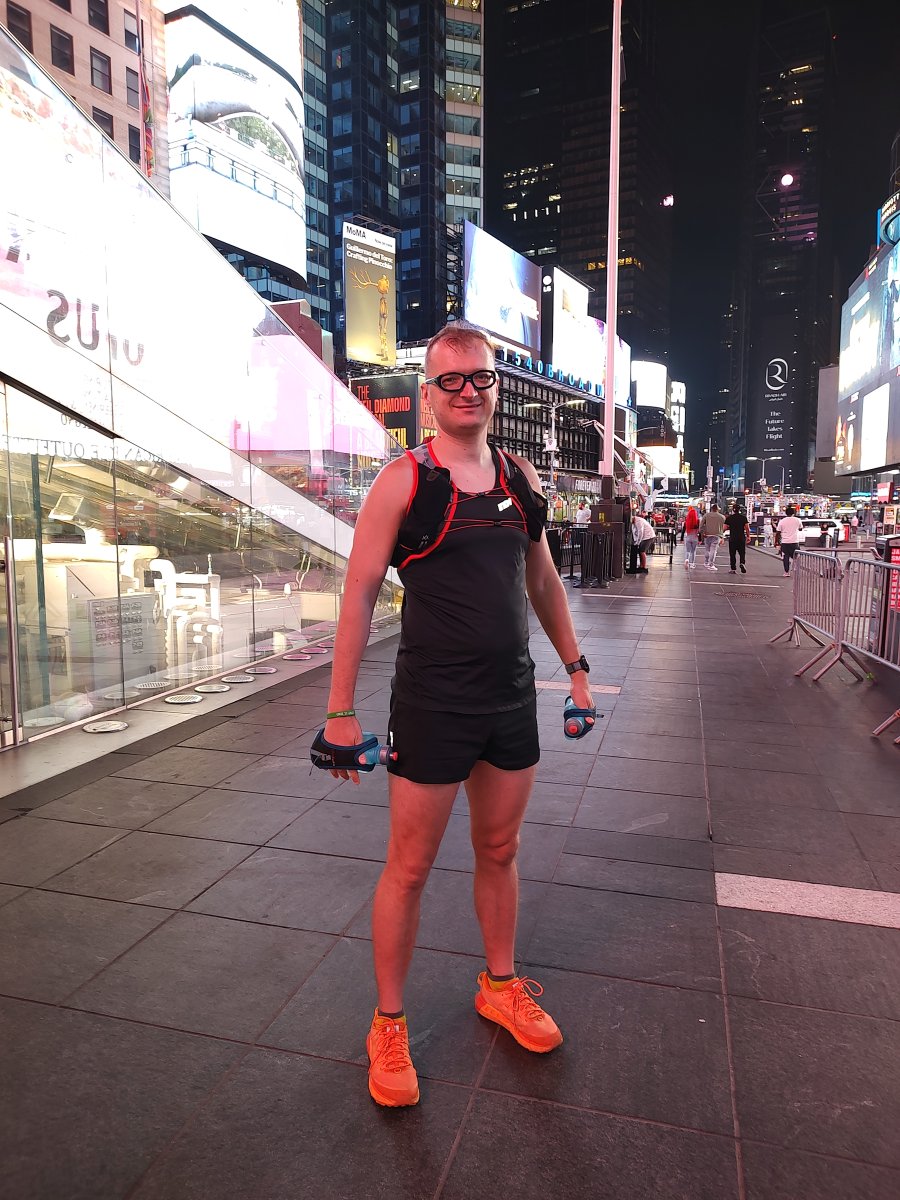
I have tackled this race twice. My first experience with the TGNY 100 was in 2023, on a day that proved to be incredibly warm and humid. Though I managed to finish, it was an immense struggle, largely due to a lack of heat acclimation.
The event offers two distances: a 100K version that concludes at Forest Park, and the full 100-mile lap returning to Times Square. After failing to draw a lottery ticket for several years in a row, 2023 was finally my lucky year. I was prepped and ready, but I didn't truly know what to expect. Unfamiliar with the nuances of an urban ultra, I foolishly assumed that because the route lacked significant elevation, it would be fine. I failed to account for the heavy, suffocating humidity. That year, survival was a brutal chore. I came incredibly close to a DNF around mile 30 due to dehydration and systemic issues. The race had started at 5:00 a.m. in Times Square, with over a hundred 100-mile runners rushing north toward Central Park. I suffered almost from the very beginning. Yet, despite the physical misery and the overwhelming urge to quit at the 55K mark, I kept pushing forward.
I finally crossed the finish line in just over 26 hours. It wasn't the time I had desired or expected, but I beat the strict 30-hour cutoff. It was physically and mentally exhausting; I had to walk extensive portions of the course. From Far Rockaway onward, my race shifted entirely into an alternating rhythm of power hiking and running due to profound fatigue.
I vividly remember traversing the Far Rockaway boardwalk in the dead of night—dark, empty, and desolate. The same went for Coney Island. Interestingly, I recall hitting the 8K stretch from Far Rockaway to Sheepshead Bay quite fast that year; I still had a reservoir of energy to propel myself forward, feeling much better in that specific section in 2023 than I would years later. Ultimately, finishing that 2023 edition left me ecstatic. Running through the living tapestry of New York's neighborhoods left a permanent impression, prompting me to keep applying for the lottery. After rejections in 2024 and 2025, my name was finally drawn again for 2026.
2026: The Return to the Asphalt
I returned to the starting line on June 20, 2026, and put together a performance that was nearly three hours faster than my debut. Looking back, I was simply better trained, better prepared, and far better acclimatized. Just two weeks prior, I had finished the Old Dominion 100—another notoriously hot and exposed race. That intense effort had thoroughly toughened my body, leaving me perfectly primed for the TGNY heat.
Navigating the 2026 course required hyper-focus. I relied heavily on the GPX file on my running watch for the entirety of the race. While the course is straightforward in theory, the reality of city racing is complex; arrows aren't always present on every sidewalk, and GPX signals can occasionally drift or become unreadable amidst the buildings. There were moments where I had to rely entirely on intuition or follow the veteran runners who knew the turns by heart.
My race day began at 2:00 a.m. on Long Island, where I caught the LIRR into Penn Station. Arriving in Manhattan around 3:30 a.m., I took the subway to 42nd Street. To build a solid calorie base before the 5:00 a.m. start, I bought a lamb over rice gyro from a street vendor. While it provided a massive surge of energy, it also paid a penalty, forcing me to make frequent bathroom stops throughout the day.
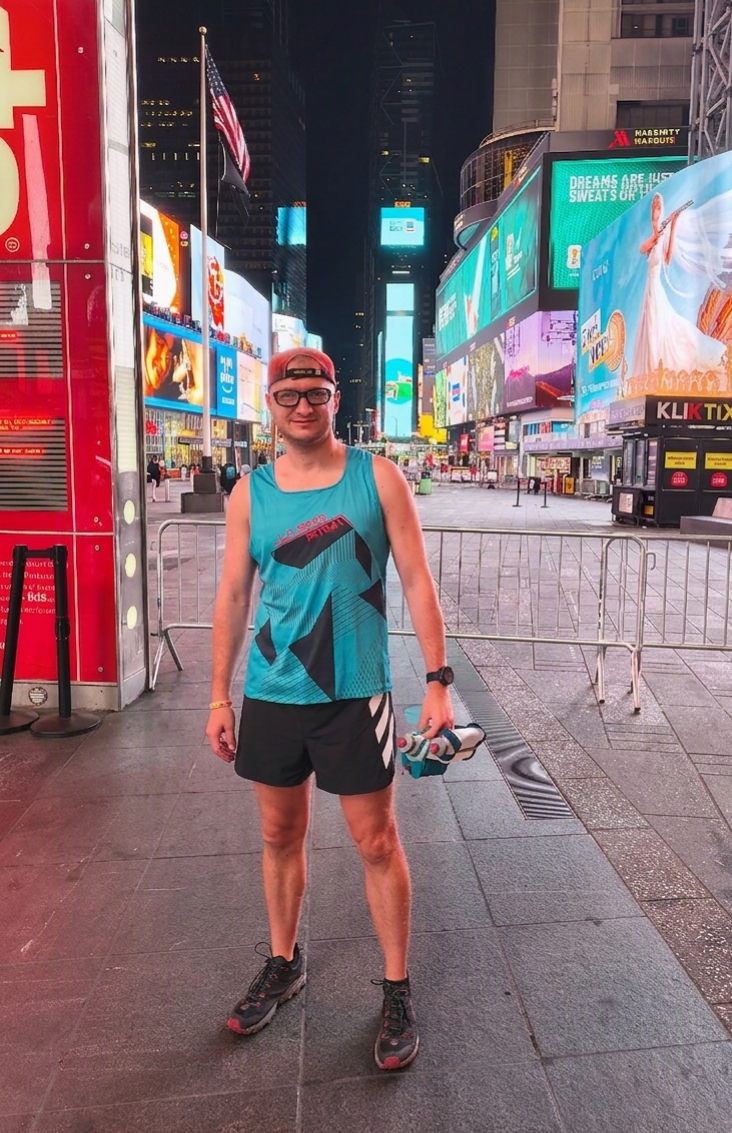
My gear strategy was minimalist and efficient: a La Sportiva singlet, La Sportiva trail running shorts, La Sportiva Helios 3 shoes, a hat, and two UltrAspire handheld bottles pre-loaded with dissolved electrolyte tablets. Armed with a few emergency protein bars and a headlamp—which I knew I’d barely need given how well-lit the city is at night—I was ready to roll.
From the Bronx to the Fury of Queens
At 5:00 a.m., our pack surged uptown toward Central Park. I focused on running light and easy, consciously saving energy. Navigating Central Park’s pavement was effortless, save for the minor rolling hill toward the end of the park. We then spilled onto the West Side and Upper Manhattan sidewalks under a beautiful, early morning weather that had not yet turned malicious.
Crossing the bridge into the Bronx, the terrain began to drop, and the atmosphere shifted. My inspiration spiked; I knew I was approaching the shaded trail sections. The surrounding neighborhoods were beautiful, and I felt full of energy as I cruised along the flat and downhill stretches.
The Bronx segment flew by, spanning roughly 60 kilometers of the journey. After passing the confluence where the Bronx River meets the ocean, I clocked a few effortless miles across beautiful Wards Island before ascending the pedestrian walkway of the Robert F. Kennedy (Triborough) Bridge.
Climbing the bridge, a surge of pure emotion hit me as I left the Bronx behind and descended into Astoria. I was in Queens now, baby, and tracking significantly faster than my 2023 pace. The air was warming up fast, and the city views from the bridge deck were spectacular—bright sun, deep blue skies, and an endless skyline. I cruised down the bridge's final descent and hit the Astoria aid station, stopping only long enough to refill my bottles with Gatorade and eat a quick protein bar before moving out.
As I approached LaGuardia Airport, massive commercial jets skimmed so low on their descent that it felt as though their wings were literally touching my head. It was an incredible sight. I passed the famous viewing spots where crowds gather for aviation selfies, but I had no time to chill. I kept cruising toward the World’s Fair Marina, eager to lock down the first 40 miles of the race.
The volunteers at the marina aid station were fantastic, and I made sure to compliment them on running such a tight ship. But leaving that station put me face-to-face with the most brutal section of the entire Queens route that would eventually follow: the paved bike and pedestrian path running parallel to the Cross Island Parkway.
Locked between the open waterfront and the roaring highway, this stretch was completely exposed to a merciless, furious midday sun. There were no trees, no buildings, and absolutely no shade. I hit it at peak heat. The pressure was immense; I desperately wanted to clear the bike path and hide behind the buildings of the next neighborhood. My stomach rebelled violently under the heat, rejecting both food and water. I was truly suffering, forced into a frustrating walk-run sequence, dreaming of the moment the lane would end.
Pushing Past the 100K Threshold
Eventually, the asphalt path relented. I navigated a blur of city streets and park trails until I finally hit the green sanctuary of Forest Park, arriving at the definitive 100K mark. I made it there in roughly 12 hours and 30 minutes—well ahead of the 17-hour cutoff. At the station, I saw several runners resting, choosing to voluntarily drop down to the 100K finish rather than brave the remaining miles of the 100-miler.
I refused to linger. My stomach was totally shot, rejecting everything, and I knew I had to find an alternative way to take in fluids. Remembering a deli I had passed back in the neighborhood, I left the aid station, walked in, and bought some unflavored seltzer. It was the perfect fix. Thanking the Forest Park volunteers, I stepped back onto the pavement to face the 10-mile stretch leading down to the Far Rockaway boardwalk.
Knowing ten long miles separated me from the ocean sounded daunting, but my 2023 experience reminded me that this stretch down to the Atlantic would ultimately be rewarding. Keeping a light, steady pace, I moved through the diverse neighborhoods surrounding Jamaica Avenue, drawing closer to Rockaway Boulevard with JFK Airport humming to my left.
Flying past the Belt Parkway, I knew I was reaching the southern tip of Queens. Soon, I hit Cross Bay Boulevard—a long, beautiful highway cutting straight through islands and over bridges toward the beach. The terrain was entirely flat, save for the rhythmic rise and fall of the bridges. I passed one aid station halfway through the boulevard and another right at the edge of the boardwalk, pausing only briefly because I was determined to clear this section before darkness fell.
Cruising west along the Far Rockaway boardwalk, the atmosphere was alive. The beach was packed with cyclists, walkers, and beachgoers, and the soundtrack to my tired stride was a live concert echoing by the entrance. Best of all, the beach restrooms were still open. In 2023, I had reached this point much later; it had been pitch black, completely deserted, and locked up. This year was entirely different. Moving at a much faster pace with fewer stops, I had beaten the darkness by three hours.
The Tremble and the Triumph
After finishing the boardwalk, I hit the aid station right before the bridge leading back toward Long Island. I took a 10-minute break, but as I sat there, my body began to tremble violently—a clear warning sign of impending hypothermia as the twilight temperature dropped. Realizing I couldn't afford to sit still, I quickly pulled my lightweight shell jacket from my shorts pocket, threw it on, and broke into a run toward the Marine Parkway Memorial Bridge to cross into Brooklyn.
The chilly wind whipping across the open water kept me shivering on the span, but by the time I descended onto the Brooklyn bike paths, my internal furnace kicked back in. I stripped the jacket off, feeling hot once more, and pushed through the evening streets toward Sheepshead Bay. The neighborhood was vibrant—filled with fancy cars, illuminated nightclubs, and bustling restaurants. Groups of locals strolled serenely along the waterfront, enjoying the night. It felt deeply alive, a stark contrast to the quiet, sleepy suburban towns of Long Island at that hour.
I rolled into the Sheepshead Bay aid station after grinding hard through that 8K stretch. The volunteers offered me fresh watermelon, which I gladly accepted (knowing it would likely revisit the Brooklyn streets a bit later). They even had a cake, which sounded incredible, but my stomach simply wasn’t having it.
Re-energized, I pushed on toward Coney Island. Arriving around 11:00 p.m., I was amazed to find the boardwalk absolutely thriving and the famous amusement park fully operational, teeming with late-night crowds. I ran across the wooden planks, using the GPX map on my watch to navigate the complex web of Brooklyn streets as I exited the boardwalk to find the path leading toward the Belt Parkway and Shore Parkway.
Hitting the Belt Parkway bike path, I tracked along Gravesend Bay, heading directly beneath the massive structure of the Verrazzano-Narrows Bridge. Running beneath its sweeping cables, watching the traffic and the brilliant night lights reflecting off the water, was spectacular. I maintained a solid pace along the coast before turning onto 4th Avenue, heading deep into Brooklyn toward Union Street, Court Street, and finally, the ultimate aid station at Borough Hall.
By the time I reached Borough Hall, a deep, heavy fatigue had settled into my bones. The mental imagery of sprinting across the Brooklyn Bridge and hammering up Manhattan to 42nd Street faded. My energy vanished, and I found myself walking toward the bridge, unable to replicate the aggressive, flying finish I had executed back in 2023.
The Final Detour
Once across the Brooklyn Bridge, I forced my legs into a relentless, rhythmic march. I couldn't run, let alone sprint, which was deeply frustrating because I remembered crushing this exact section years ago. To cope, my mind defaulted to its European wiring; I tuned out the exhaustion by counting down the kilometers and watching the Manhattan street numbers tick upward. 4th Street, 12th, 14th, 23rd, 32nd, 40th...
Then, exhaustion played a trick on my brain. In a haze of fatigue, a phantom memory convinced me that the finish line was on 47th Street.
I marched right past 42nd Street and kept tracking uptown. When I finally reached 47th Street, I stopped, looked around, and realized the intersection was completely empty. No banners, no timers, no crowd. In a flash of sudden clarity, reality hit me: The finish line was back on 42nd Street at Times Square.
Letting out a loud curse, I spun on my heels and channeled every ounce of remaining adrenaline into a full-blown sprint back downtown. I burst into Times Square, spotting the race director, and the rest of the crew. I was overwhelmed with pure joy that the journey was finally over. I ran up to them, laughing through my exhaustion, shouting that I had completely messed up the routing but had still made it.
Even with that 10-minute accidental detour through midtown, I crossed the line with a sub-24-hour finish. I was ecstatic. I had shaved nearly three hours off my 2023 time. I proudly accepted my finisher’s belt buckle, chatted for a few minutes with the late-night race crowd, grabbed my gear bag, and walked down into the subway—eager to surprise my wife and kids with a much earlier arrival than anyone had expected.